
Visual attention helps you select relevant information while competing details are present. Everyday examples include finding an object on a crowded shelf or following one line through a complex diagram.
The exercises below practice specific visual operations. They are not a treatment for attention disorders, and improvement on an exercise does not automatically imply a broad change in everyday attention.
1. Timed visual search
Choose a detailed image and define one target before you start: every circular object, every repeated symbol, or one specific color-shape combination. Scan systematically rather than moving your eyes at random.
Record time and missed targets. On the next attempt, use a consistent left-to-right or grid-based scan and compare the result.
2. Edge-matching practice
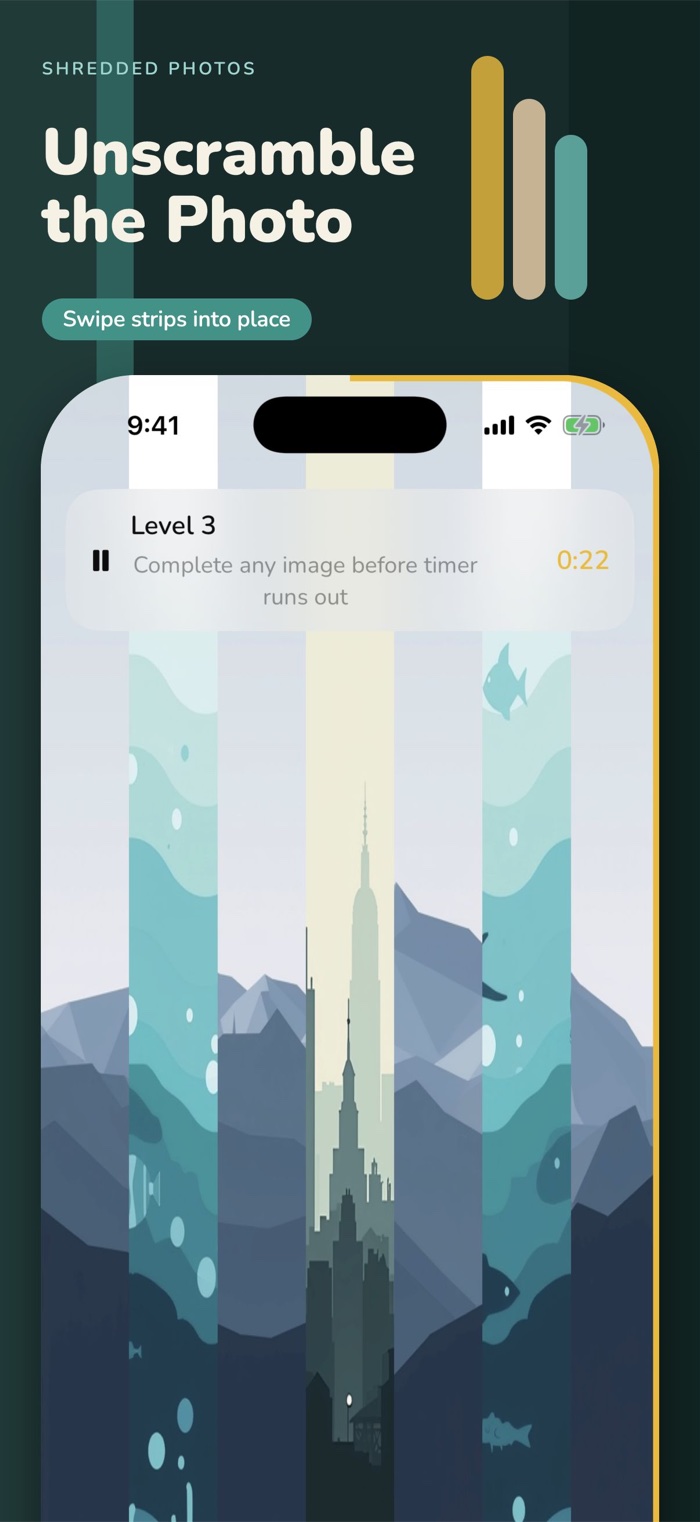
Split an image into several vertical fragments and reconstruct it by comparing adjacent edges. Start without a timer and describe the cues you use.
- Continuation of lines and horizons.
- Matching texture and color gradients.
- Expected position of faces or objects.
- Perspective and lighting direction.
3. Figure-ground switching
Look at a visually dense scene and alternate between describing the main subject and the background. Then search for a small target while resisting attention-grabbing but irrelevant details.
This practices switching the selection rule rather than simply staring at the image longer.
4. Spot-the-difference with a scan plan
Compare two similar images by dividing them into the same imaginary grid. Check corresponding regions in a fixed order. A scan plan reduces repeated checking and makes mistakes easier to diagnose.
5. Rapid pattern classification
Prepare a small set of visual patterns and sort them by a stated rule—for example symmetry, orientation, or repetition. Change the rule and sort the same set again.
Accuracy comes first. Add a short timer only after the categories are clear.
A sustainable daily session
Five to ten focused minutes are enough for a repeatable practice session. Remove notifications, choose one task, and stop before fatigue turns the exercise into guessing.
- Two minutes of visual search.
- Three minutes of untimed reconstruction.
- Three minutes of a timed but comfortable challenge.
- One minute to review errors and the cues you missed.
Using PixPuzz for structured practice
PixPuzz provides repeated photo-strip reconstruction with adjustable difficulty and timed modes. Use it to practice the mechanics it contains and track in-game accuracy or completion—not as a medical assessment.