
Visual puzzles feel simple because the goal is visible. The work underneath is a sequence of attention and comparison decisions: select a fragment, inspect its cues, compare candidates, and update the arrangement.
That process explains why a short puzzle can feel demanding. It does not prove that playing will broadly improve concentration outside the task.
Visual search guides the first move
In visual search, you look for a target among distractors. Search is guided by a working description of the target—its color, shape, orientation, or expected location.
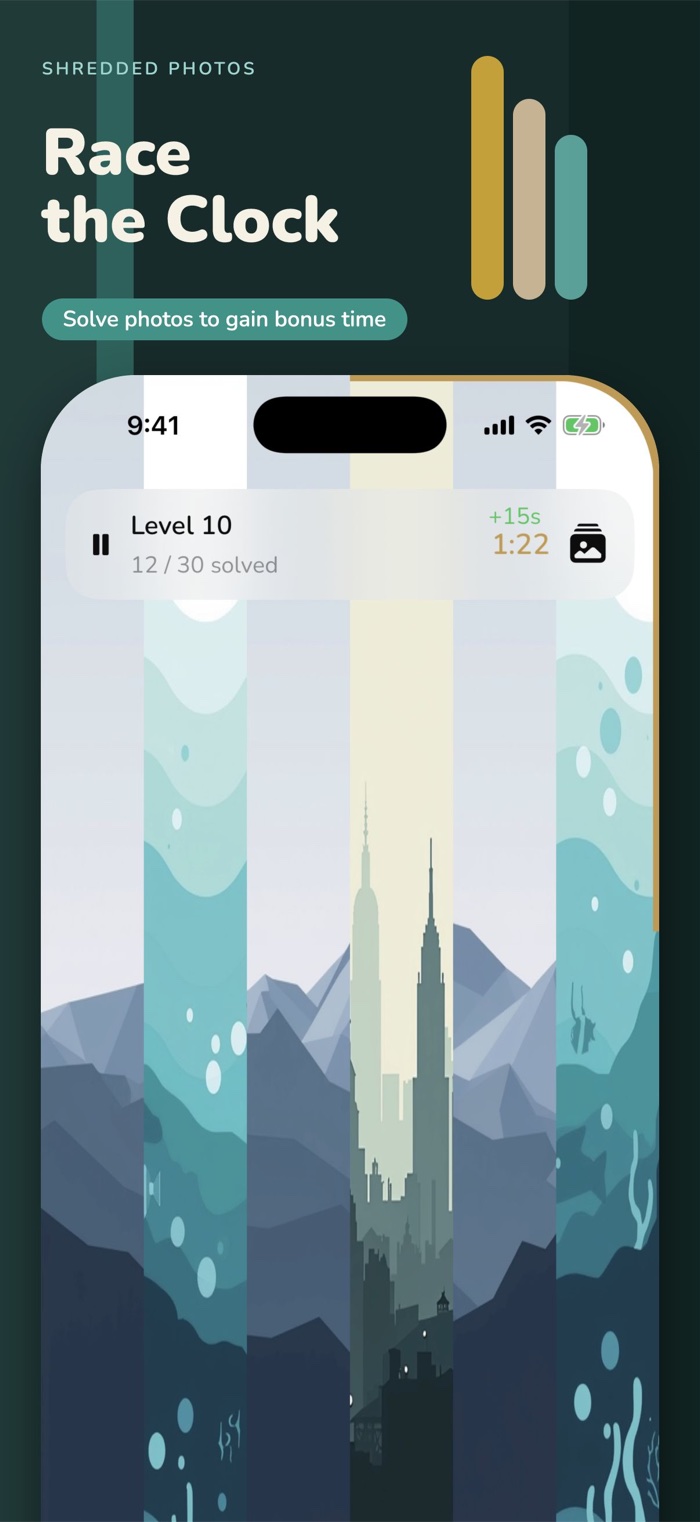
In a photo-strip puzzle, the target may be the continuation of a horizon or the missing half of an object. Strong cues narrow the search; weak cues require more comparisons.
Pattern recognition connects fragments
A correct pair usually shares several relationships: aligned edges, consistent perspective, compatible texture, and a plausible position in the full scene.
Players gradually learn which cues are reliable for this specific task. That is task learning, and it should not be confused with evidence of a general cognitive upgrade.
Working memory keeps alternatives active
When no match is obvious, you may hold one fragment in mind while checking several candidates. As the image becomes more complete, the number of plausible alternatives shrinks.
A good interface reduces unnecessary memory load by keeping fragments visible and making the result of each move immediate.
Why a timer changes the experience
A timer adds a speed-accuracy tradeoff. It can increase urgency and discourage exhaustive comparison, but more pressure is not always better.
Useful difficulty keeps the player making interpretable decisions. If the timer produces random swiping, it is measuring panic and luck more than visual reasoning.
Design features that support deliberate practice
Progressive challenge, immediate feedback, varied images, and adjustable difficulty make game-specific progress visible. They also help prevent one memorized layout from dominating performance.
- Begin with fewer, wider strips.
- Increase fragment count after accurate completion.
- Vary subject, contrast, texture, and composition.
- Show time and errors separately.
- Offer an untimed mode when accuracy is the goal.
What PixPuzz does—and does not claim
PixPuzz is a photo puzzle game built around visual search, edge comparison, sequencing, and timed decisions. Those are the operations performed during play.
The app is not a medical product. It does not diagnose attention, treat a condition, or guarantee improvement in school, work, memory, or everyday focus.
Bottom line
Visual puzzles create a compact environment for practicing their own visual and decision rules. That is a clear, testable benefit. Claims about broader transfer must be evaluated separately with controlled evidence.