

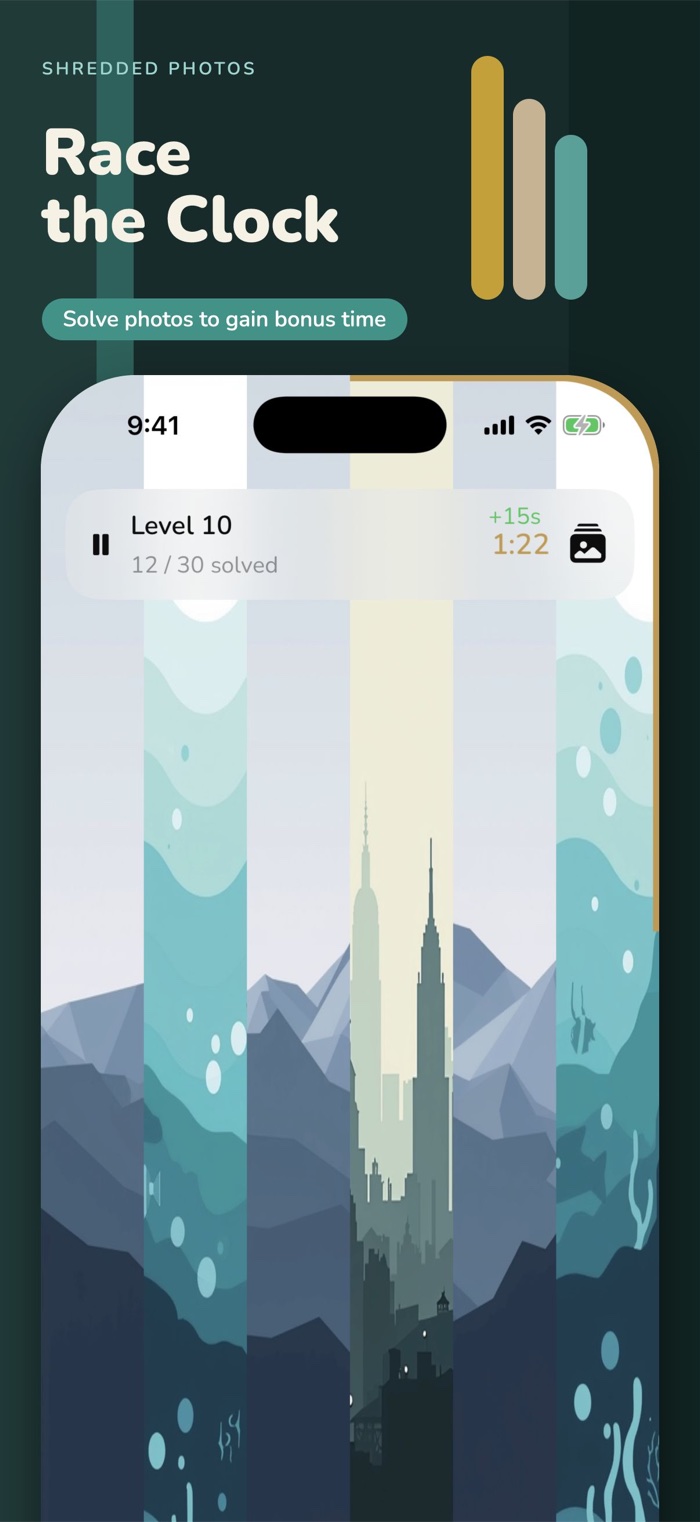
Speed comes from reducing unnecessary comparisons, not from swiping sooner. A consistent search order makes each move easier to justify and makes mistakes easier to diagnose.
The method below is designed for PixPuzz-style vertical photo strips, but the same idea applies to many visual reconstruction puzzles.
1. Scan the complete set before moving
Spend a few seconds identifying the subject, major horizontal lines, distinctive objects, and broad color regions. This creates a rough map of the image.
Starting immediately often means rediscovering the same structure one move at a time.
2. Place the strongest anchors
Begin with fragments whose approximate position is clear: an outer edge, a face, text, a strong horizon, or a unique object. Anchors reduce the number of plausible positions for every remaining strip.
3. Compare boundaries systematically
Choose one open boundary and test candidates against it in a fixed order. Look for multiple agreeing cues instead of relying on general color.
- Line and contour continuation.
- Texture and lighting consistency.
- Object geometry across the cut.
- Plausible position in the overall composition.
4. Build outward from confirmed pairs
A reliable pair is more useful than two isolated guesses. Extend a confirmed region one boundary at a time and leave ambiguous fragments until more context is available.
5. Track corrections as well as time
Record completion time and the number of moves you had to undo. If time falls while corrections rise sharply, you are trading method for guessing.
Practice untimed until the process is stable, then use Bonus Time or another timed mode to test it under pressure.
A compact solving routine
Scan, anchor, match one boundary, extend a confirmed section, and postpone ambiguous pieces. Repeat the same routine across varied images so improvement is not tied to one memorized picture.