
“Brain power” is not a single scientific outcome. A photo puzzle can clearly exercise the operations required to solve it, but improvement in the game does not by itself demonstrate better memory, intelligence, productivity, or everyday attention.
The honest answer is narrower and still useful: repeated play can make you more efficient at the task and may help on closely related visual problems.
What a photo puzzle asks your brain to do
During a solve, you search for relevant details, compare boundaries, recognize continuities, keep alternatives active, and update the arrangement after each move.
These are real task demands. Describing them is different from claiming the game changes a broad mental ability.
Practice effects are real but specific
People generally improve at activities they repeat. They learn the interface, discover reliable visual cues, and make fewer unnecessary comparisons.
The strongest evidence for brain-training products is usually improvement on the trained task. Evidence becomes weaker as the claimed benefit moves farther away from the practiced activity.
Why broad claims need separate evidence
A higher PixPuzz score can show progress inside PixPuzz. It cannot establish that school, work, memory, reaction time, or a health condition has improved.
Those outcomes require controlled studies that measure the claimed ability directly and compare training with an appropriate control.
How to use a puzzle realistically
Treat a photo puzzle as entertainment and deliberate practice for its own mechanics. Track completion time, errors, difficulty, and consistency rather than translating one score into a general diagnosis.
- Prioritize accurate decisions before speed.
- Vary images and difficulty.
- Review the cue behind repeated errors.
- Stop when fatigue turns comparison into guessing.
- Use qualified care—not an app—for medical concerns.
What Brain XP means in PixPuzz
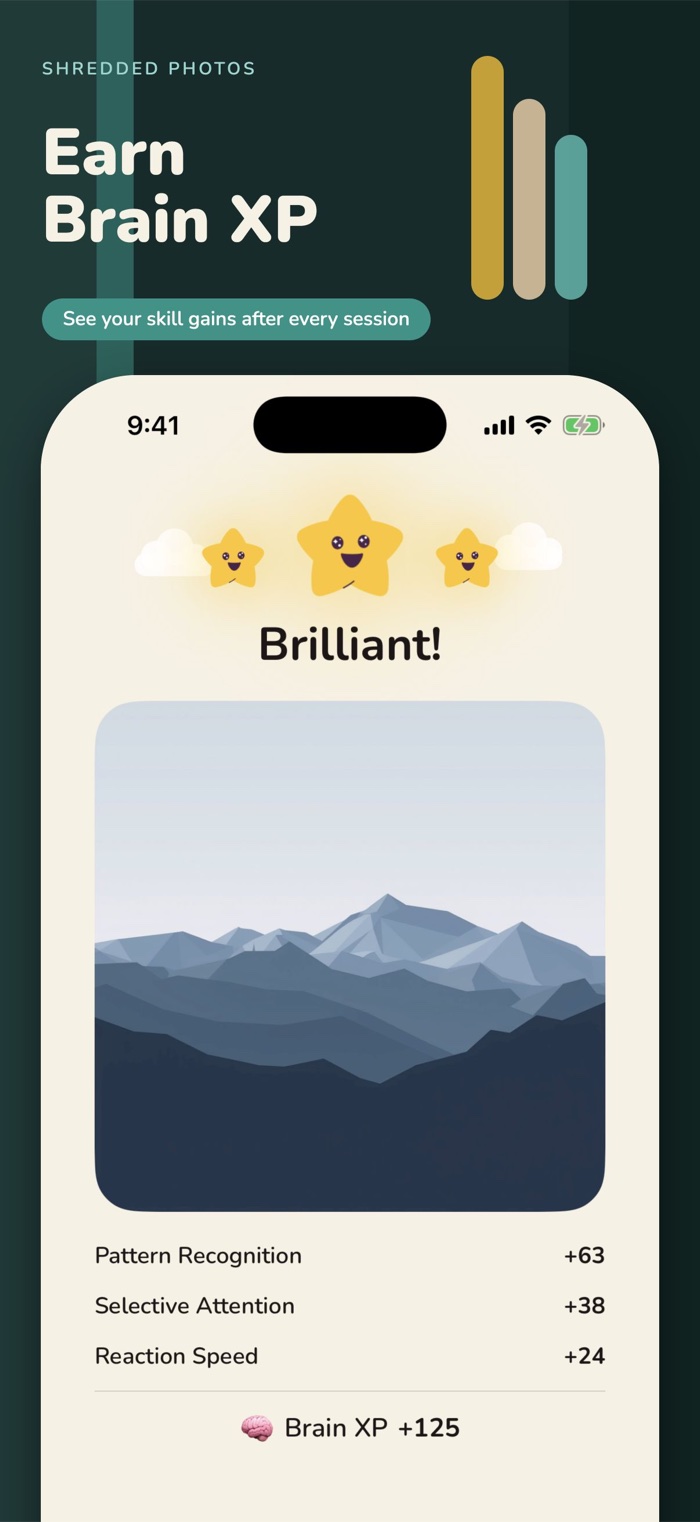
Brain XP is an in-app progression measure tied to PixPuzz activity. It helps represent progress through the product; it is not a clinical score or a measurement of intelligence.
Use it as game feedback, not as evidence of a change outside the game.
Bottom line
Photo puzzles provide focused practice in visual search, comparison, and sequencing. They can be engaging and measurable without promising a general cognitive upgrade.